On a multi-axle vehicle or trailer, not every axle does the same job. Some carry, others steer. The steering axle is the one that controls trajectory by transmitting directional input to the wheels. Once confined to cars and heavy trucks, it now appears across a wide range of sectors wherever a heavy machine’s ability to manoeuvre in tight spaces matters as much as its load capacity.
What is a steering axle?
On a conventional rigid axle, the wheels are fixed relative to the chassis. The vehicle can only travel in a straight line. The steering axle solves this by incorporating a king pin, a mechanical component that allows each wheel to rotate around a vertical axis. That rotation is what makes cornering possible.
Control can be mechanical, hydraulic or electrohydraulic depending on the vehicle and the precision required. On a standard car, the steering wheel drives the column, which acts on a rack, which turns the stub axles. On an industrial or agricultural trailer, control is often slaved to the towing vehicle’s steering or driven by a standalone hydraulic system. In all cases, the steering axle sits at the heart of the vehicle’s directional geometry, and how it integrates with the rest of the structure shapes the handling of the whole combination. The article on trailer chassis structure and axle integration gives a useful overview of how these elements interact.
How a steering axle works
Everything starts at the king pin. When the steering command acts on the stub axle, the wheels pivot and alter the vehicle’s path. What seems simple hides a significant geometric constraint: to corner without tyre scrub, the two steered wheels must not pivot by the same angle. The inner wheel, tracing a smaller circle, needs to steer more sharply than the outer one. This is Ackermann geometry, and an axle that ignores it will wear its tyres prematurely.
On hydraulically controlled axles, a double-acting cylinder converts circuit pressure into angular wheel movement. Three design parameters govern performance: guidance precision, maximum steering angle and response speed. These figures vary considerably depending on the application.
Three main control families exist:
- Mechanical control: direct transmission via column, rack or track rod. Simple, robust, no power assistance, suited to moderate loads.
- Hydraulic control: cylinder slaved to the tractor’s circuit or a dedicated power pack. High steering force and precision, essential on heavy loads.
- Electrohydraulic control: sensor and solenoid valve driven. Enables automatic slaving to the towing vehicle’s steering, used on long trailers and special convoys.
Self-steering axle vs steering axle: what’s the difference?
Both allow wheel orientation, but in completely different ways. A self-steering axle reacts passively to the lateral forces generated in a corner. No command intervenes: suspension geometry naturally produces the orientation. The result is that the vehicle tracks better, but the driver has no direct control over the steering angle.
A steering axle, by contrast, is actively commanded. The driver, or a slaved system, controls the angle at all times. That level of control is what makes the difference in demanding situations: manoeuvring in confined spaces, transporting abnormal loads, handling a long articulated vehicle. The trajectory precision of a proper steering axle has no equivalent on the self-steering side.
| Criterion | Rigid axle | Self-steering axle | Steering axle |
|---|---|---|---|
| Wheel orientation | Fixed | Passive (lateral forces) | Active (command) |
| Manoeuvrability | Low | Good | Excellent |
| Trajectory precision | No | Partial | Yes |
| Mechanical complexity | Low | Moderate | High |
| Typical applications | Light trailers | Heavy semi-trailers | Industry, construction, airport |
Industrial applications and use cases
In the airport sector, pushback tractors, passenger transporters and cargo dollies operate on marked apron areas that are often narrow. Steering precision there is critical: a misjudged turn is an incident. Steering axles are frequently paired with electronic guidance systems to guarantee repeatable trajectories. Under EASA and UK CAA ground operations standards, ground support equipment must meet specific manoeuvrability requirements that directly shape axle specification.
In construction and abnormal load transport, convoys stretching dozens of metres use hydraulic steering axles front and rear simultaneously to negotiate turns that would be impossible in a rigid configuration. Power transformers, structural sections, industrial reactors: this category of transport simply does not exist without a steering axle on every module.
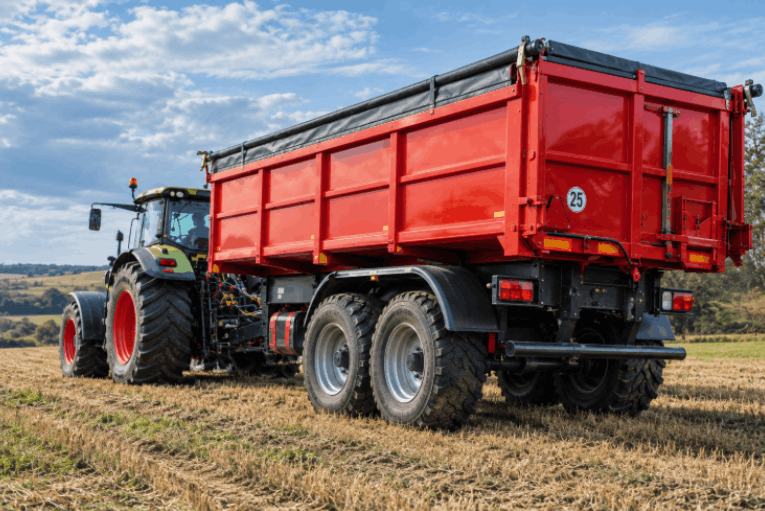
In agriculture, large combine harvesters, self-propelled sprayers and root crop harvesters use steering axles rated for several tonnes on uneven ground. These configurations consistently fall outside standard catalogues and require specific development, as illustrated by the solutions in our range of agricultural applications of steering axles.
In port logistics and warehouse operations, AGVs and terminal tractors use electrohydraulic steering axles for precise movement on quaysides or in storage facilities, frequently in fully automated mode with no driver on board.
Sizing: why off-the-shelf rarely works
Maximum steering angle, turning radius, camber and caster geometry, compatibility with the tractor or machine’s hydraulic system, chassis packaging constraints: sizing a steering axle is a global exercise. None of these parameters can be addressed in isolation from the others.
Standard configurations cover the most common cases. The moment load, geometry or system integration fall outside catalogued ranges, the answer is design. That is where our range of bespoke steering axles for non-standard geometries comes in, developed axle by axle from the actual constraints of each application, with our design office involved from the specification stage.
In summary
The steering axle is a precision component whose specification goes well beyond load capacity. Whether mechanically, hydraulically or electronically controlled, its job is to ensure the manoeuvrability and trajectory accuracy of a heavy vehicle in conditions that are often unforgiving. In industrial, agricultural and airport sectors, off-the-shelf solutions rarely cut it. The design office is what makes the difference.