Overrun braking is one of the most widely used systems on braked trailers. Reliable, self-contained, and independent from the towing vehicle’s braking circuit, it is a proven solution across the road trailer industry.
However, it can cause confusion during manoeuvres, particularly when reversing.
Wheel lock-up, unusual resistance, or the feeling that the trailer “refuses” to move are common situations when the operating principle of an overrun brake is not fully understood. Let’s take a closer look at why this occurs, and how to reverse properly with a braked trailer.
What Is Overrun Braking?
Overrun braking is a fully mechanical and autonomous braking system, primarily fitted to trailers with a GVWR (Gross Vehicle Weight Rating) exceeding 750 kg.
Unlike hydraulic or electric systems, it operates without any direct control input from the towing vehicle.
The principle is straightforward:
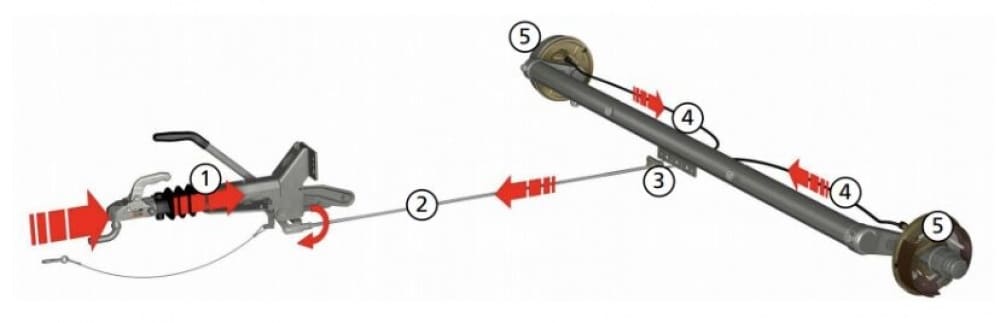
When the towing vehicle brakes, the trailer continues moving forward due to inertia. This forward thrust compresses the sliding coupling head — known as the overrun coupling — which mechanically actuates the trailer’s wheel brakes.
This system equips the majority of road trailer axles, particularly for commercial, industrial and professional applications where reliability and simplicity are key.
Why Can Overrun Braking Cause Issues When Reversing?
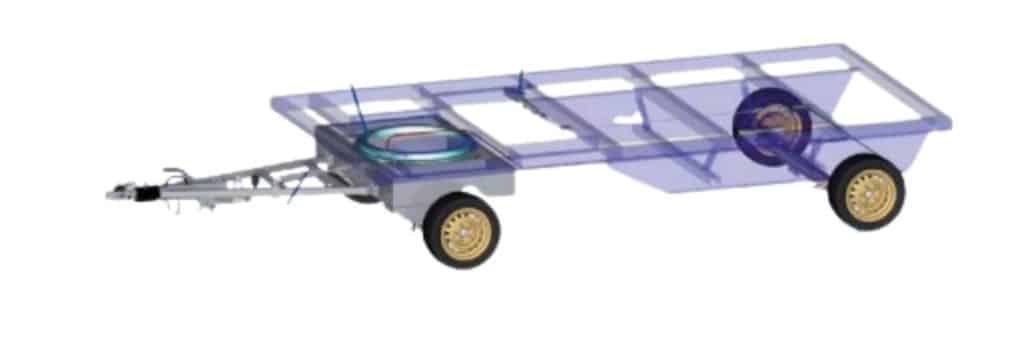
When reversing, the situation is reversed:
The towing vehicle pushes the trailer backward. The overrun mechanism cannot distinguish between forward braking and reverse compression.
As a result:
- The coupling head compresses
- The mechanism interprets this compression as a braking action
- The trailer brakes engage
- The wheels may partially or fully lock
This is why reversing a braked trailer without a suitable device can become difficult — or even impossible — particularly on inclines or uneven ground.
The Role of the Automatic Reverse Mechanism
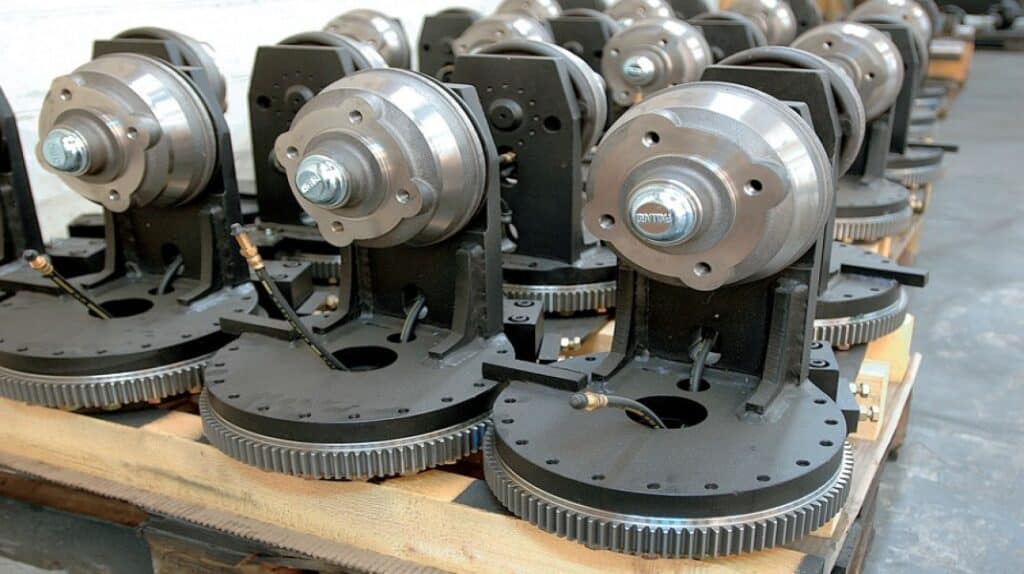
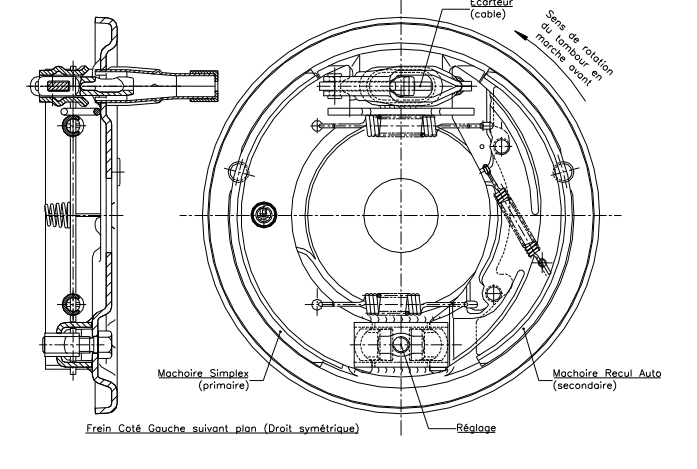
To overcome this limitation, most modern braked trailers are equipped with an automatic reverse system integrated into the wheel brake assemblies.
During reversing, this mechanism temporarily disengages the braking effect, typically through an internal geometry within the brake shoes. Even if the overrun coupling compresses, the wheels are allowed to rotate freely in reverse.
Today, this feature is standard on the majority of braked trailer axles — provided that the system is correctly adjusted and properly maintained.
How to Reverse Properly with an Overrun-Braked Trailer?
Safe and smooth manoeuvring requires only a few simple practices. These help prevent wheel lock-up and avoid sudden jerks:
- Reverse slowly and progressively, avoiding abrupt movements
- Avoid sharp throttle inputs that increase compression on the coupling
- Whenever possible, manoeuvre on flat ground or a slight downhill gradient
Smooth driving allows the automatic reverse mechanism to function correctly and ensures better control.
Special Case: Trailers Without Automatic Reverse
Some older or specific trailer models may not be fitted with an automatic reverse release system. In such cases, reversing can become challenging.
The usual solution involves manually locking out the braking system, typically using:
- A mechanical blocking wedge
- A dedicated lever on the coupling head
- A manufacturer-specified lockout device
These solutions must remain temporary and must be removed before resuming forward travel.
The Importance of a Properly Maintained Coupling and Axle
Difficult reversing may also indicate a mechanical issue, such as:
- Seized or poorly lubricated overrun coupling
- Fatigued or worn compression spring
- Incorrectly adjusted brake linkage
- Worn or improperly positioned brake shoes
Regular inspection and maintenance of braking components are essential to ensure reliable performance — both in forward braking and during manoeuvres.
Trailer axles and braking systems should be periodically inspected, especially in intensive or professional use. High-quality components and correctly engineered axle systems play a crucial role in ensuring smooth operation, safety, and durability.
In this regard, the braking and coupling solutions available at Paillard provide reliable replacement and upgrade options for both standard road trailer axles and bespoke axle assemblies.
Summary Table: Overrun Braking and Reversing Behaviour
| Situation | Trailer Behaviour |
|---|---|
| Forward travel – braking | Normal brake activation |
| Reversing with automatic system | Wheels rotate freely, manoeuvre facilitated |
| Reversing without release device | Partial or total wheel lock |
| Abrupt manoeuvre | Increased risk of brake activation |
Best Practices for Safe Manoeuvring
Reversing with a braked trailer requires anticipation, but quickly becomes intuitive with proper technique. Slow manoeuvres, well-maintained equipment, and a correctly adjusted braking system make all the difference.
Overrun braking remains a robust, safe and widely proven solution — provided its operating principle and reverse behaviour are fully understood.
In Summary
Overrun braking can complicate reversing if its mechanical principle is not clearly understood. Thanks to automatic reverse systems and appropriate driving technique, it is entirely possible to manoeuvre a braked trailer smoothly and safely.
High-quality axle assemblies, correctly adjusted couplings, and regular maintenance remain the key factors for safe and reliable operation — whether in occasional use or demanding professional applications.