
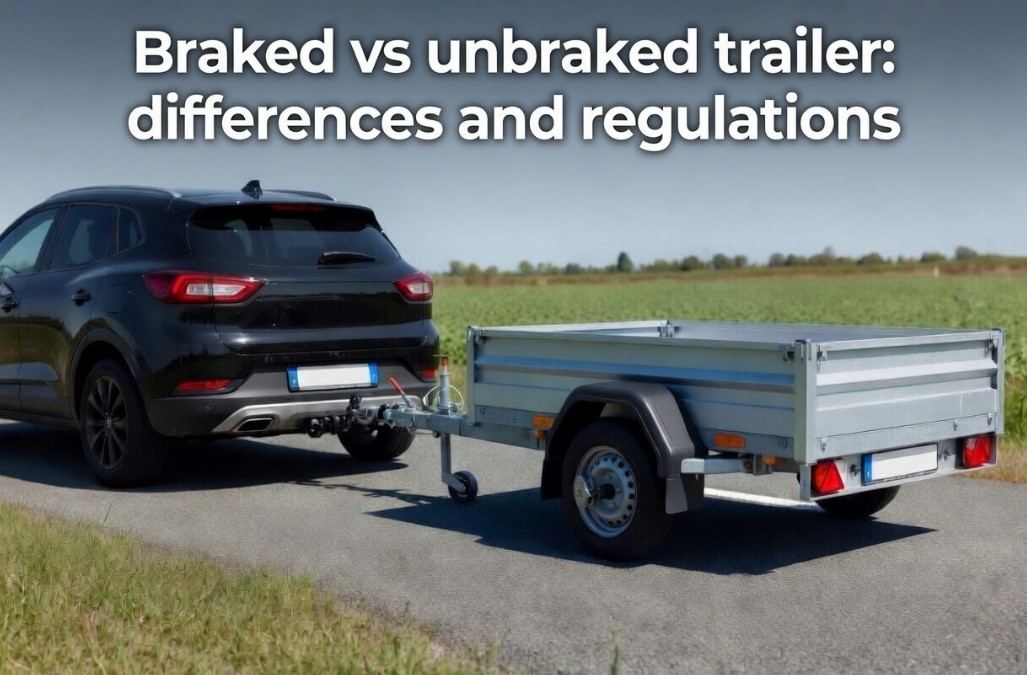
When looking for a braked 750 kg trailer, the braking question comes up early in the decision process, and it’s not always well understood. Braked or unbraked is not a comfort feature: it’s a technical characteristic governed by UK law, which depends on the trailer’s weight, the towing vehicle and the intended use.
Unbraked trailer: when is it permitted under UK law?
An unbraked trailer has no braking system of its own. It stops solely through the towing vehicle’s brakes. It’s the simplest configuration, the cheapest to buy and the least demanding to maintain.
Under the Road Vehicles (Construction and Use) Regulations 1986, an unbraked trailer is permitted under two cumulative conditions: the trailer’s MAM (Maximum Authorised Mass) must not exceed 750 kg, and the laden weight of the trailer must not exceed half the kerbweight of the towing vehicle.
That second condition is often overlooked, yet it can change everything. A towing vehicle with a kerbweight of 1,200 kg can only tow an unbraked trailer laden to a maximum of 600 kg, even if the trailer’s registered MAM is 750 kg. Once the load exceeds that threshold, braking becomes mandatory, regardless of what the V5C says.
Braked 750 kg trailer: the overrun brake as standard
Once either of the two conditions above is no longer met, the trailer must be fitted with a braking system. For light trailers with a MAM between 750 kg and 3,500 kg, the overrun brake (also called inertia brake) is the most widely used solution.
Its operation is mechanical and automatic: when the towing vehicle brakes, the trailer pushes against the coupling. This push activates a mechanism that applies the trailer’s brakes in proportion to the deceleration. No complex hydraulic or electronic connection is required, which makes it the standard solution for trailers in this category.
On a braked 750 kg trailer, the axle plays a central role in braking performance. A trailer axle fitted with drum or disc brakes must be sized consistently with the vehicle’s MAM and actual operating conditions. An ill-matched axle reduces braking efficiency and accelerates lining wear.
What braking actually changes on a 750 kg trailer
The stopping distance of an unbraked combination is significantly longer than that of one where the trailer has its own brakes. On a wet road or a downhill stretch, the difference can be substantial, and the trailer continues to push against the towing vehicle throughout deceleration.
Beyond safety, braking has a direct impact on the towing vehicle’s wear. Towing a loaded unbraked trailer puts extra strain on the vehicle’s brakes, shortens the lifespan of pads and discs, and increases the risk of overheating on routes with prolonged descents.
| Configuration | Trailer MAM | Mass condition | Braking required |
|---|---|---|---|
| Unbraked | ≤ 750 kg | Laden trailer ≤ ½ towing vehicle kerbweight | No |
| Unbraked | ≤ 750 kg | Laden trailer > ½ towing vehicle kerbweight | Yes |
| Braked (overrun) | 750 kg to 3,500 kg | No condition | Yes |
| Braked (assisted) | > 3,500 kg | No condition | Yes |
Licences, MOT and what else changes at 750 kg
The 750 kg MAM threshold also has implications beyond the braking system itself. Under UK law, a standard category B licence allows you to tow a trailer up to 750 kg MAM. Above that, a category B+E licence is required if the combined MAM of the vehicle and trailer exceeds 3,500 kg, or if the trailer’s MAM exceeds the unladen weight of the towing vehicle.
On the MOT side, trailers under 3,500 kg MAM are not currently subject to a mandatory annual test in the UK, though the government has periodically reviewed this position. That said, roadworthiness remains a legal obligation: a trailer in poor condition, braked or not, can result in prosecution under the Highway Code.
Maintenance and key checks on a braked axle
A braked axle requires regular maintenance that an unbraked axle does not. Brake linings wear down, cables or actuators lose tension, and the overrun brake mechanism can seize up after prolonged exposure to moisture or corrosion, particularly on boat trailers that are regularly launched.
A few things to check periodically:
- condition of the brake linings or pads
- play in the overrun mechanism
- condition of the handbrake cable
- lubrication of moving parts
A poorly maintained overrun brake can lock in the braked position, causing the trailer to drag continuously, or it can stop actuating entirely.
For trailers used in demanding conditions or subject to intensive load cycles, bespoke axles with a tailored braking configuration can be a more reliable solution than off-the-shelf catalogue products.
In summary
The choice between a braked and unbraked trailer is not arbitrary. It follows from a straightforward calculation between the towing vehicle’s kerbweight and the laden trailer mass, combined with the trailer’s MAM. Running an unbraked trailer beyond the permitted thresholds is both a technical risk and a legal offence under UK law.
And for those still in doubt, a braked 750 kg trailer remains the safer option in the vast majority of cases, whatever the actual load being carried!