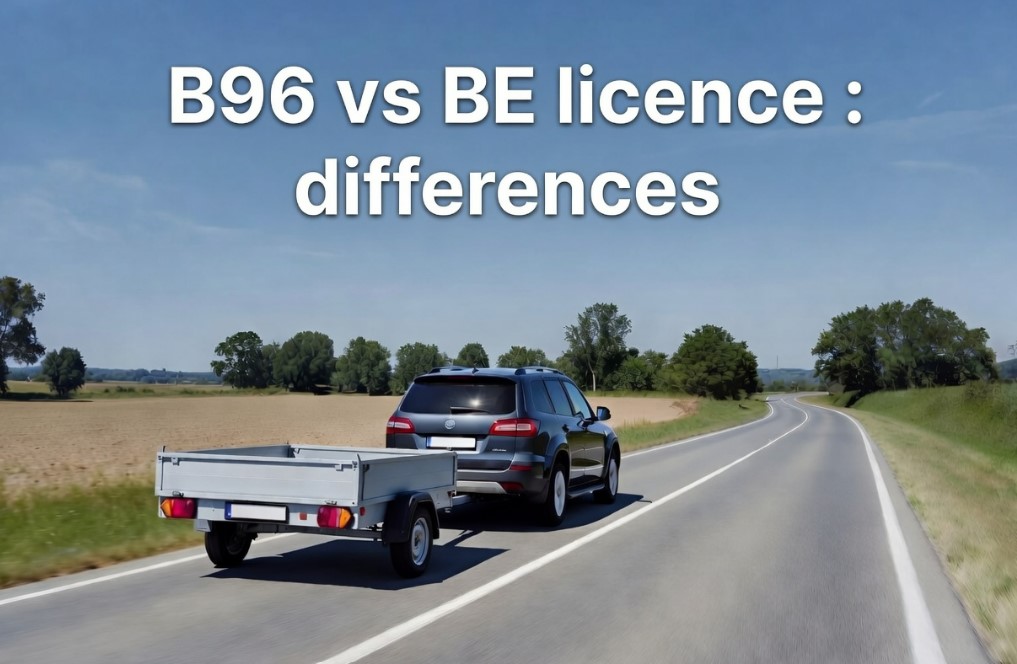
The 750 kg MAM threshold is where towing regulations begin. Below it, a standard category B licence is enough. Above it, two extensions exist: B96 and B+E. Many drivers confuse the two, or are unaware that B96 exists at all. Yet the choice between these two categories matters: it determines the training required, the administrative process and, above all, which trailer configurations are permitted on the road.
B, B96, BE: the logic behind the three levels
A standard category B licence allows you to tow a trailer with a MAM up to 750 kg, provided the total combination mass stays below 3,500 kg. Beyond that threshold, two options exist depending on the total weight of the combination envisaged.
B96 is an extension obtained after a minimum 7-hour practical training course with an approved instructor. No theory test, no driving exam. It allows combinations with a total mass between 3,500 kg and 4,250 kg, on the condition that the trailer’s MAM does not exceed the unladen weight of the towing vehicle.
Category BE is a full licence in its own right, requiring a complete training programme and a practical test with a DVSA examiner. It covers combinations with a total mass above 4,250 kg, with a trailer MAM of up to 3,500 kg.
What B96 actually changes in practice
B96 is often the right answer for drivers who regularly tow heavy trailers without reaching full professional configurations. A motorhome with a luggage trailer, a laden car transporter, a van with a plant trailer: these are typical B96 use cases.
The 7-hour training focuses on handling the combination, manoeuvring and understanding the dynamic behaviour of a long, heavy outfit. It can generally be completed in a single day at an approved training centre. No application to the DVLA is needed: the B96 entitlement is added directly to the licence after the training is validated.
One point that is frequently misunderstood: the trailer’s MAM must not exceed the unladen weight of the towing vehicle. A vehicle weighing 1,800 kg unladen cannot tow a trailer with a 2,000 kg MAM on a B96 entitlement alone, even if the total combination mass stays below 4,250 kg.
When BE becomes necessary
BE is required as soon as the total combination mass exceeds 4,250 kg, or when the trailer’s MAM exceeds the unladen weight of the towing vehicle. It is the qualification needed for professional use: heavy agricultural equipment, industrial trailers, construction vehicles.
BE training is more extensive and leads to a practical exam assessed by a DVSA examiner. It covers complex manoeuvres, coupling and uncoupling, and driving in varied conditions. Once the BE licence is obtained, no mass restriction applies to the trailer within the 3,500 kg MAM limit.
Comparison table: B, B96 and B+E
| Licence | Total combination mass | Max trailer MAM | Training | Exam |
|---|---|---|---|---|
| B | ≤ 3,500 kg | 750 kg | None | No |
| B96 | 3,500 to 4,250 kg | ≤ unladen towing vehicle weight | 7h min | No |
| BE | > 4,250 kg | 3,500 kg | Full course | Yes |
Trailer and braking: the technical implications of each licence
The licence category directly conditions the technical specifications of the trailer. Both B96 and B+E take you out of the territory of light unbraked trailers. Any trailer with a MAM above 750 kg must be fitted with a braking system. For a clear explanation of how this works and what it means in practice, the article on braked vs unbraked trailers covers it in full.
A trailer built for BE combinations will also typically have a twin axle, a more robust braking system and a heavier chassis structure. Understanding how these components fit together — drawbar, coupling, axles, wheel brakes, is covered in the article: What is a chassis made up of?. And for everything that applies below the 750 kg threshold, the article on 750 kg GTW trailers sets out the regulatory framework.
In summary
B96 or BE: the choice depends primarily on the total combination mass and the relationship between the trailer’s MAM and the towing vehicle’s unladen weight. B96 covers the vast majority of intermediate use cases with a short training course and no exam. BE is required as soon as configurations become genuinely heavy or professional.
In either case, the technical characteristics of the trailer must match the load level actually authorised!