
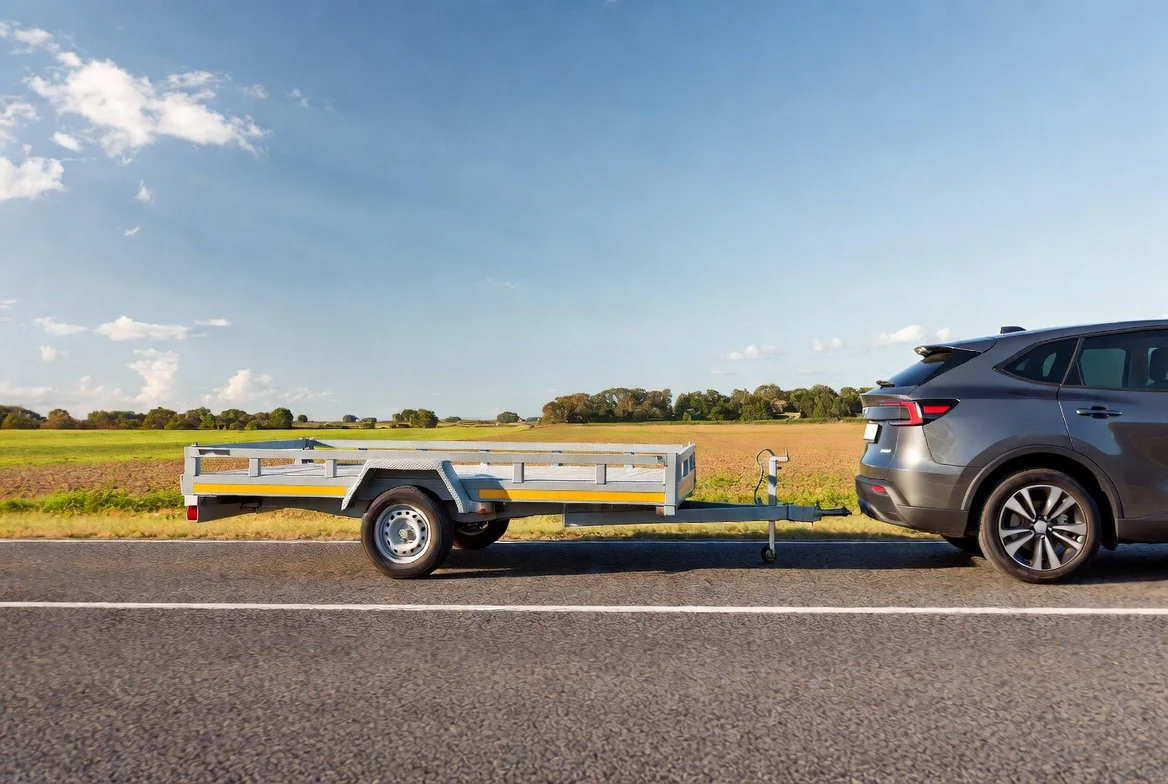
Flatbed, tipper, car transporter, boat trailer… the choice is wide, and it’s not always easy to find your way around. The wrong choice is costly: an undersized trailer wears out quickly, an oversized one makes manoeuvring harder and adds unnecessary weight to the combination. A few simple questions asked upfront go a long way towards finding the right equipment.
Use, frequency, load: the three questions to ask first
The type of trailer follows directly from three parameters: what you’re transporting, how often, and how heavy.
A private user who moves garden equipment two or three times a year has very different needs from a tradesman loading tools every morning. Equally, carrying a quad bike doesn’t call for the same equipment as towing a 600 kg boat.
Frequency of use directly affects the level of quality required — particularly for the axle, wheels and braking system. Intensive use demands more robust components, even if the loads themselves remain modest.
The main trailer types and their uses
The market breaks down into a few broad families, each suited to distinct needs.
The flatbed trailer is the most versatile. With no fixed sides or bodywork, it takes bulky or irregularly shaped loads: building materials, light plant equipment, large furniture. It’s the default choice for tradespeople and private users with varied requirements.
The sided trailer or tipper has removable panels that make bulk loading easier: rubble, soil, green waste, firewood. Practical for building work and gardening, it handles heavy, dense loads well.
The car transporter or plant trailer is designed to carry vehicles: broken-down cars, motorcycles, quads, mini-excavators. It typically includes access ramps and tie-down points. Its GTW is often higher, which means the appropriate licence and towing vehicle must be factored in.
The boat trailer has a specific structure with adjustable cradles and rollers to make launching easier. It should be chosen based on the boat’s dimensions and weight, as well as how often it will be launched.
The box or refrigerated trailer is more relevant for professionals: transporting goods protected from the weather, sensitive equipment, food. Less common among private users but essential in certain industries.
| Trailer type | Main use | Typical GTW | Axle |
|---|---|---|---|
| Flatbed | Versatile, materials, light plant | 500 to 3,500 kg | Single or double |
| Sided / tipper | Bulk loads, rubble, vegetation | 750 to 2,000 kg | Single or double |
| Car transporter | Vehicles, plant equipment | 2,000 to 3,500 kg | Double |
| Boat | Launching, nautical transport | 500 to 2,500 kg | Single or double |
| Box / refrigerated | Protected goods | 1,500 to 3,500 kg | Double |
GTW and licence: matching the trailer to the towing vehicle
Choosing a trailer isn’t just about the load — it also depends on the vehicle doing the towing. Every vehicle has a maximum towing capacity stated in its owner’s manual or on its registration document. Exceeding that figure isn’t just illegal, it’s dangerous.
A few useful reference points:
- Below 750 kg GTW, a category B licence is sufficient in most cases.
- Between 750 kg and 3,500 kg GTW, you need to check that the total combination mass stays under 3,500 kg on a category B licence, or obtain a BE licence.
- Above 3,500 kg total combination mass, a BE licence is mandatory, without exception.
Before buying, comparing the intended GTW against the towing vehicle’s rated capacity is a step that cannot be skipped.
Single axle or double axle: what it means in practice
Axle configuration is one of the most defining criteria when choosing a trailer. A single axle keeps the overall weight down, makes manoeuvring easier and reduces maintenance costs. It’s the right choice for light to moderate loads and occasional use.
A double axle improves stability under load, distributes weight more evenly across the road surface and provides added safety in the event of a puncture — the trailer remains controllable even with a flat tyre. It becomes the natural choice once the GTW exceeds 1,500 kg or when use is intensive.
For non-standard configurations — specific frame geometry, unusual load distribution, out-of-the-ordinary load requirements — custom axles make it possible to tailor the solution precisely to the application, without compromising on safety or performance.
Coupling, wheels and accessories: don’t overlook the peripherals
A well-chosen trailer can be let down by poorly matched peripheral equipment. The trailer hitches must be approved and compatible with the towing vehicle’s ball — the standard diameter is 50 mm, though some professional setups use different norms.
Wheels must be suited to the load and the maximum speed of use. An undersized tyre overheats, deforms and eventually blows — usually at the worst possible moment. Checking the load index and speed rating before any replacement is a simple but effective precaution.
Finally, parking stands, jockey wheels, protective covers, lighting — these elements are as much a part of safety as they are of everyday convenience. They’re usually the last thing people think about, yet they’re often what makes the difference in day-to-day use.
In summary
There is no universal trailer. The right choice depends on actual use, the weight being transported, frequency of use and the towing vehicle’s capabilities. Taking the time to clarify these four parameters before buying avoids a lot of problems — and ensures equipment that lasts.