
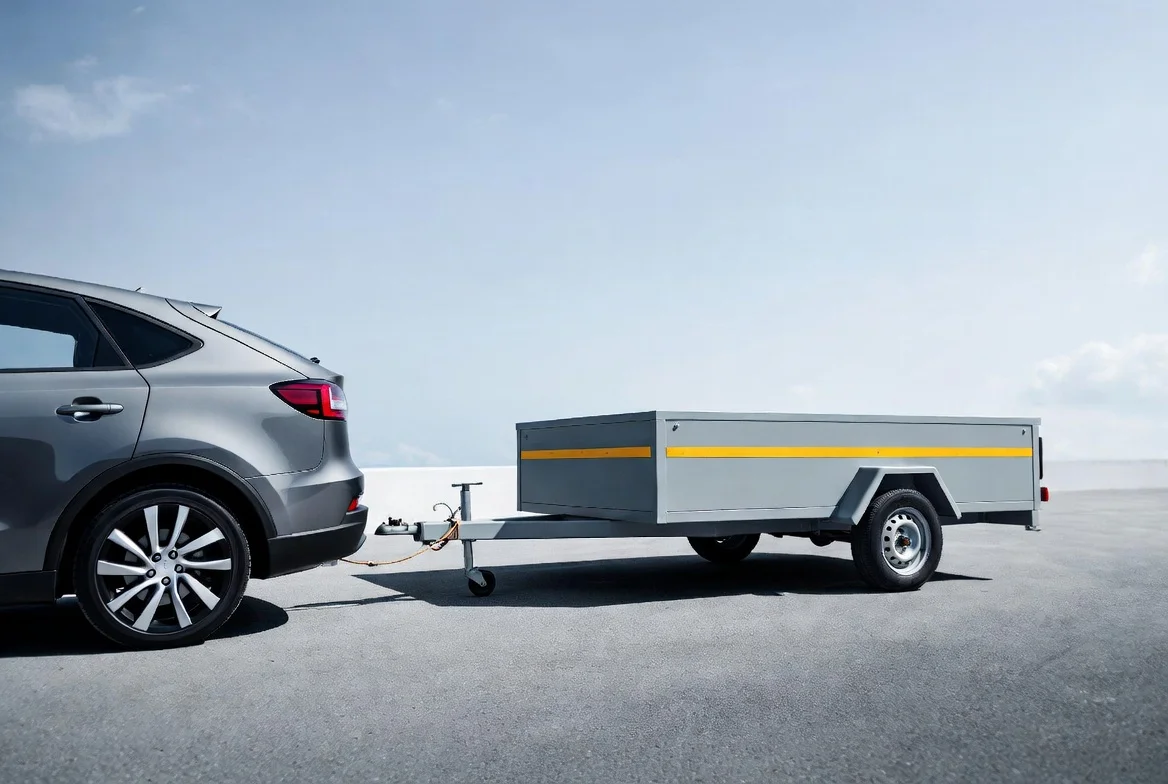
The 750 kg GTW mark is the threshold found on virtually all light trailers sold to private buyers. Gardening, motorcycle transport, small boat, occasional moving… this category covers a very wide range of everyday uses. But behind this figure lie specific rules, and above all technical concepts worth understanding before loading your trailer.
750 kg GTW: what does it actually mean?
The GTW — Gross Train Weight — is the maximum mass a trailer can reach when loaded, including the vehicle’s own empty weight. It is a value set by the manufacturer and recorded on the registration document. It does not correspond to what you can put inside, but to the total weight of the trailer plus its load combined.
This matters, because many users confuse GTW with payload capacity. More on that below.
Regulations: what the 750 kg threshold changes
In France, this threshold directly determines the obligations of the driver. Below 750 kg GTW, the requirements are lighter:
- Category B licence is sufficient, as long as the total mass of the combination (towing vehicle + trailer) does not exceed 3,500 kg. Above 750 kg GTW, a BE licence becomes mandatory.
- No MOT required for light trailers in this category.
- Registration: not required below 500 kg GTW. Between 500 and 750 kg, registration is mandatory, but the process remains straightforward.
Exceeding this threshold — even by a few kilos on the scales — therefore changes the entire legal framework that applies.
Payload, kerb weight, GTW: three distinct concepts
This is the most common source of confusion. GTW is not the load you can carry. Payload is what the trailer can actually transport, and it is calculated as follows:
Payload = GTW − Kerb weight
A trailer with a GTW of 750 kg and a kerb weight of 180 kg only allows 570 kg of cargo. Loading 750 kg of rubble into it means exceeding the GTW — and risking premature wear or an accident.
| Concept | Definition | Example |
|---|---|---|
| GTW | Maximum authorised mass (empty + load) | 750 kg |
| Kerb weight | Weight of the unloaded trailer | 180 kg |
| Payload | What can effectively be loaded | 570 kg |
| Axle capacity | Maximum load supported by the axle | ≤ axle GTW |
Checking the kerb weight of a trailer before any purchase or use is therefore essential.
The axle at the heart of load limits
The axle bears the weight of the load and transfers it to the road. Its nominal capacity must be consistent with the vehicle’s GTW — neither below it, nor unnecessarily above it.
For a trailer with a 750 kg GTW, a standard axle is generally suitable. But it still needs to be correctly sized for the actual conditions of use: journey frequency, road type, nature of the load. An undersized axle wears prematurely and can fail. An overly heavy axle, on the other hand, needlessly eats into the available payload.
Load distribution matters as much as total weight. A load concentrated too far behind the axle causes a snaking effect, which is dangerous at higher speeds. The centre of gravity should ideally sit slightly ahead of the axle.
For a better understanding of how to identify your trailer’s configuration from official documents, the article on the number of axles on a trailer registration document may be useful.
Braking, coupling and accessories: the details that matter
On a trailer under 750 kg, an unbraked axle is generally permitted — provided the loaded trailer mass does not exceed half the mass of the towing vehicle. Beyond that, an inertia brake is required by law.
The rest of the equipment deserves the same attention: approved coupling, sound electrical wiring, properly secured safety chains. These accessories are often treated as an afterthought, yet they are an integral part of the combination’s safety.
Finally, if the trailer has an unusual configuration — non-standard frame, unconventional load distribution, specific technical use — custom axles make it possible to get a truly tailored solution, rather than forcing a specific need into an off-the-shelf product.
In summary
750 kg GTW is both a technical limit and a regulatory reference point. Not confusing this figure with the actual payload, checking that the axle is correctly sized, and paying attention to the trailer’s full equipment: these are the three things to keep in mind to tow safely and legally.
FAQ: 750 kg trailers
Does a 750 kg trailer need to be registered?
Yes, a trailer with a GTW between 500 and 750 kg must be registered and therefore has a registration document. Below 500 kg GTW, registration is not required.
What licence do you need to tow a 750 kg trailer?
A category B licence is sufficient to tow a 750 kg GTW trailer, provided the total mass of the combination — towing vehicle and trailer together — does not exceed 3,500 kg. If that threshold is exceeded, a BE licence becomes necessary.
Is it compulsory to insure a 750 kg trailer?
Yes. Once a trailer is registered, it must be covered by third-party liability insurance. In practice, many car insurance policies automatically cover an attached trailer, but it is worth checking your policy terms before setting off.
Can you tow a 750 kg trailer without a licence?
No. Even for a light trailer, a valid driving licence is required. Category B is the legal minimum for this type of combination. Towing without a licence carries criminal penalties, regardless of the trailer’s weight.