
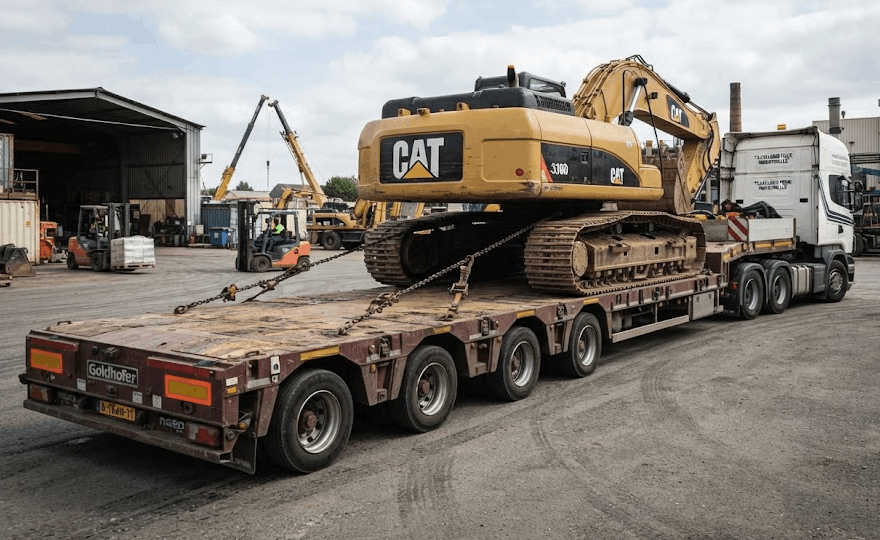
On an industrial tow tractor, a factory trailer or a logistics vehicle, the axle works in conditions that road use never sees: constant stop-start cycles, tight turns, concentrated loads and concrete or damaged floors. Choosing the right material handling axle starts with understanding those constraints.
Material handling covers a wide range of equipment: three- and four-wheel tow tractors, industrial trailers towed in trains, heavy load platforms and machines built for a single site. What they share is their duty cycle. They move slowly but constantly, often across several shifts a day, and every unplanned stop has a direct cost in lost throughput.
That is why most projects end up with bespoke axles for material handling, sized around the actual machine and the way it is used rather than picked from a catalogue. Here are the technical challenges to get right and the solutions that address them.
Material handling axle constraints: loads, duty cycles and impacts
A road axle is designed for regular journeys at sustained speed, with a load that is evenly spread and fairly stable. A material handling axle faces the opposite: low speeds, but repeated and often abrupt stresses. Every laden pull-away, every stop and every tight turn generates longitudinal and lateral forces that concentrate on the stub axles, the wheel bearings and the chassis mounting points.
The load itself adds to the challenge. On a handling trailer it is rarely centred and rarely constant: a heavy part placed at the end of the deck, a forklift dropping a pallet onto the platform, a trailer running empty and then fully laden within the same hour. The axle has to absorb these variations without permanent deformation and keep the wheels aligned over time. Otherwise tyre and bearing wear accelerate, and machine availability drops with them.
Typical constraints on a material handling equipment axle:
- Intensive duty cycles: frequent starts and stops, two- or three-shift operation.
- Lateral forces in the tight turns imposed by aisles, loading bays and storage areas.
- Point loads and impacts during loading, particularly by forklift.
- Mixed floor surfaces: smooth concrete, cracked tarmac, thresholds, embedded rails, wet outdoor yards.
- Tight packaging: ground clearance, deck height and track width dictated by the site.
Rigid axle, steering axle or kingpin: which layout for handling equipment?
The first decision concerns what the axle has to do. A rigid axle carries the load without steering the wheels. It is the simplest and most robust option, suited to trailers that follow their tractor along open routes and to very high loads. A steering axle turns the wheels and governs how manoeuvrable the whole unit is. To understand how a steering axle works, look at the kingpins and the mechanical or hydraulic control that set the steering angle and turning circle.
On handling tractors, the layout depends on the number of wheels. A three-wheel tractor uses a steering kingpin at the front, which carries the load while turning the wheel during manoeuvres. A four-wheel tractor, which Paillard equips for loads from 1,000 to 1,500 kg, relies on a full axle. On heavy trailers, a mechanically steered axle follows the tractor’s path and limits tyre scrub in turns.
Examples of Paillard material handling axle configurations:
| Application | Axle type | Max payload | Braking | Suspension and steering |
|---|---|---|---|---|
| Three-wheel tractor | Steering kingpin | 1,000 kg | Disc or drum brake | Shock absorber, mechanical steering |
| Heavy duty trailer | Steering axle | 17,000 kg | Parking drum brake | No suspension, mechanical steering |
| Heavy duty trailer | Rigid axle | 24,000 kg | No brake | No suspension or steering |
These three cases show how broad the sector is: from 1,000 to 24,000 kg, with layouts that have almost nothing in common. The single term “material handling axle” covers components of completely different design.
Braking and suspension on a material handling axle
Braking is chosen according to the moving mass, the speed and the site layout. On a tractor, disc and drum brakes both have their place. Discs shed heat better over very close cycles, while drums remain popular for their robustness and good protection against dust. On a heavy trailer moving at walking pace, a parking drum brake is often enough to hold the load during operations, with the tractor handling deceleration.
Suspension is not a given. At very high loads and low speeds, a rigid axle keeps the deck height constant, which makes forklift loading easier and improves load stability. On a tractor that is constantly on the move, a built-in shock absorber filters out floor irregularities, protects on-board components and reduces driver fatigue. The right balance comes from the machine’s usage profile, not from a standard.
Sizing a bespoke axle for material handling
Sizing a material handling axle starts with the load but does not stop there. The maximum load per axle must account for the real distribution across the deck, dynamic overloads during loading and a margin that matches how hard the machine works. A trailer running continuously across three shifts is not sized like one moved a few times a week.
Then come the interfaces: chassis mounting, track width, wheel diameter and stud pattern, and the space available for the brakes and steering control. This is where bespoke axles for special vehicles make the difference: the design office starts from the machine’s constraints instead of adapting the machine to an existing axle.
Information to gather before contacting an axle manufacturer:
- Unladen weight, maximum payload and load distribution between axles.
- Maximum speed, gradients and floor surfaces encountered.
- Intensity of use: number of shifts, cycles per hour.
- Required function: rigid axle, steering axle or kingpin, with the target turning circle.
- Braking: service brake, parking brake, type of control.
- Packaging: track width, deck height, mounting points, wheel dimensions.
- Environment: indoor or outdoor, humidity, corrosive products.
2026 regulations for material handling equipment in the UK
In Great Britain, self-propelled handling machines placed on the market fall under the Supply of Machinery (Safety) Regulations 2008. Since the Product Safety and Metrology etc. (Amendment) Regulations 2024, the CE marking is recognised indefinitely for machinery, so UKCA marking is optional for most products.
Updates to the 2008 Regulations are expected, broadly aligned with the EU Machinery Regulation 2023/1230, which replaces the Machinery Directive across the EU on 20 January 2027. For a manufacturer supplying both markets, the technical documentation of every component, the axle included, needs to be ready now.
In service, PUWER 1998 requires work equipment to be maintained in a safe condition and inspected where deterioration could create a risk. Forklift trucks, as lifting equipment, also fall under LOLER 1998: they need a thorough examination at least every 12 months, or every 6 months if used to lift people, unless a written examination scheme sets other intervals. Tow tractors and industrial trailers with no lifting function sit under PUWER only, but axles, brakes and wheel ends still belong in the inspection regime.
Material handling axle maintenance: bearings, kingpins and brakes
Intensive use concentrates wear on a handful of components. Wheel bearings run hotter and wear faster under short, repeated cycles. The kingpins of a steering axle develop play. Brake linings wear at the rate of every stop. Regular checks of bearing play, kingpin lubrication and brake condition stop ordinary wear from turning into downtime.
The warning signs are well known: bearing noise, an abnormally hot hub, uneven tyre wear, steering that pulls or binds. On an axle sized with enough margin, these interventions stay infrequent and predictable. That is one of the most practical arguments for bespoke design: an axle matched to real use ages more slowly than a standard axle run at the limit of its capacity.
In summary
A material handling axle works at low speed but under constraints that road use never imposes: intensive duty cycles, concentrated loads, tight turns and mixed floor surfaces. Between rigid axle, steering axle and kingpin, between disc and drum brakes, with or without suspension, each machine calls for its own combination, from 1,000 kg on a three-wheel tractor to 24,000 kg on a heavy duty trailer. In this sector, bespoke sizing is not a luxury: it is what keeps equipment available over the long term.