
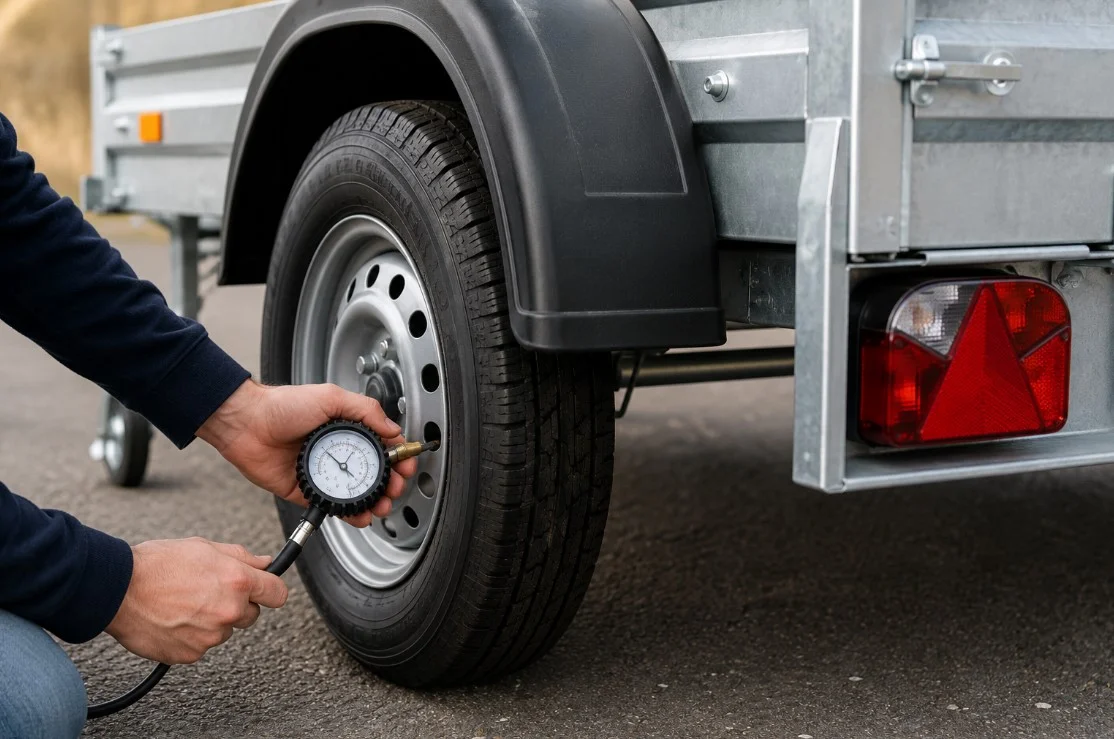
Trailer tyres on a 750 kg trailer are subject to different stresses than those on a car: prolonged static loads, sudden loading and braking forces, temperature swings across the seasons. Yet their pressure is rarely checked with the same diligence as the towing vehicle’s tyres. That’s a mistake. An incorrectly inflated trailer tyre wears unevenly, reduces the stability of the combination and can blow out without any warning.
Inflation pressure: where to find the reference figure
The recommended pressure for a 750 kg trailer’s tyres is shown on the tyre sidewall itself, as a maximum figure in bar (or PSI). This is the value that applies — not the towing vehicle’s tyre pressure. It varies according to tyre size and load index.
For light trailers in this category, the recommended pressure typically falls between 3 and 5 bar (43 to 73 PSI), depending on the tyre’s dimensions and nominal load rating. A compact trailer tyre in 145/80 R13 will generally be inflated to around 4 bar (58 PSI), while a wider 195/50 R13 may call for 3.5 bar (51 PSI) at full load.
The trailer manufacturer may also specify a pressure in its technical documentation. Where figures differ, always apply the lower of the two values — and never exceed the maximum pressure shown on the sidewall.
Under-inflation and over-inflation: two distinct risks
Under-inflation is by far the more dangerous situation. An under-inflated tyre deforms excessively under load, generating heat through internal friction. On a loaded motorway run, this overheating can cause delamination or a blowout with no prior warning. Under-inflation also causes accelerated wear on the sidewalls and instability at the axle, which feeds directly into the combination’s handling.
Over-inflation is less dangerous but equally problematic in terms of wear. An over-inflated tyre runs on its centre section, producing an uneven wear strip in the middle of the tread. The excessive rigidity also amplifies shocks and vibrations transmitted to the axle, accelerating bearing and suspension component wear.
In both cases the outcome is the same: a tyre that wears badly and needs early replacement. Correct pressure protects not just the tyre, but the overall lifespan of the trailer axle.
Load, temperature and pressure: the interactions to understand
Tyre pressure is not a fixed value: it changes with temperature. A tyre inflated to 4 bar (58 PSI) when cold will read 4.3 to 4.5 bar (62 to 65 PSI) after a few miles on the road, simply from the air inside warming up. This is entirely normal and accounted for in the manufacturer’s reference values.
This is why pressure must always be checked cold — before any journey or after covering less than 2 miles at low speed. Correcting a warm tyre’s pressure means adjusting the wrong baseline figure.
The load being carried also influences the optimal pressure. For trailers whose load varies significantly from one trip to the next, some manufacturers recommend different pressures for loaded and unloaded conditions. In practice, maintaining the maximum recommended pressure at all times is often the simpler approach, unless the manufacturer explicitly states otherwise.
| Situation | Recommended pressure | Risk if ignored |
|---|---|---|
| Unloaded trailer, short trip | Standard cold pressure | Uneven wear |
| Loaded trailer, long journey | Maximum cold pressure | Blowout, instability |
| Winter temperatures | Check more frequently | Under-inflation from temperature drop |
| Extended storage | Inflate to maximum pressure | Flat-spot deformation under static load |
Load index and speed rating: what to check on the sidewall
Pressure alone isn’t enough to ensure tyre safety. Two other values on the sidewall deserve checking whenever a replacement is fitted: the load index and the speed rating.
The load index (expressed as a number — for example, 82 equates to 475 kg per tyre) indicates the maximum mass the tyre can support at the recommended pressure. On a 750 kg single-axle trailer with two tyres, each tyre must be capable of supporting at least 375 kg. In practice, it’s worth choosing an index with a margin above the minimum required.
The speed rating (a letter: N for 87 mph, P for 93 mph, Q for 99 mph) indicates the maximum operating speed. In the UK, light trailers are limited to 60 mph on single carriageways and 70 mph on dual carriageways and motorways — an N rating is technically sufficient, but a higher rating provides useful thermal headroom on long summer journeys.
Fitting a replacement tyre with a lower load index than the original is a common mistake with serious potential consequences. For trailers whose MAM is close to the 750 kg limit, these figures should always be verified alongside the regulations that apply at that threshold.
How often to check and good habits to adopt
Trailer tyres lose pressure faster than car tyres, precisely because they often sit stationary for extended periods. A trailer stored for several months without a check can show a pressure well below the recommended figure by the time it next goes on the road.
Good habits to adopt:
- Check pressure before every use, especially after any period of storage
- Always measure cold, before any journey or after less than 2 miles at low speed
- Visually inspect the sidewalls for cracks, bulges or deformation
- Don’t forget the spare wheel if the trailer carries one
In winter, falling temperatures reduce pressure by roughly 0.1 bar (1.5 PSI) per 10°C drop. A trailer inflated to 4 bar in summer can show 3.6 bar in cold weather without having lost a single molecule of air. A check at the start of each season is particularly worthwhile.
In summary
Tyre pressure on a 750 kg trailer is a simple variable to control, but one that is frequently overlooked. Check cold, respect the sidewall values, adjust for load and verify the load index and speed rating at every replacement: these four habits are enough to avoid the majority of tyre-related problems on the road. A correctly inflated tyre also means an axle that lasts longer and a combination that handles predictably.